


As Atte Isomäki from the Finnish company Viima quite rightly pointed out in his company blog, everyone—well, almost everyone—has the potential to be creative. Essentially, it's about using this potential properly, and this applies above all to medium-sized and large companies. They have vast resources and an overwhelming number of employees, so it's somewhat surprising that they tend to fail when it comes to innovation. Even if the blame is quickly placed on the staff (“Our employees aren't the most creative”), there are always many reasons why innovations fail or, worse, are not even attempted in the first place.
Let's take a curious look at some of the reasons why companies stumble in innovation projects on the following pages.

The Problem with Focus
A lack of innovation strategy or unclear communication of this strategy means that innovation projects can no longer be efficiently steered in the right direction. If innovation teams are given insufficient objectives, they quickly lose focus on working toward a goal. This changes the direction of projects, leading to wasted time and resources.
Lack of Skills or Turf Wars
The magic word is “teamwork”! And just like entrepreneurs, intrapreneurs should pool their skills instead of building on gaps. However, companies often bring together freelancers from different departments for innovation tasks without paying attention to the overall result in terms of expertise.
The Underestimated Factor of Creativity
Creativity is often underestimated because companies that do not work in industries where creativity is used as standard, such as architecture, graphic design, advertising, media studies, etc., tend to underestimate this factor. Yet creativity is a crucial factor in the entire innovation development process chain, from idea generation and idea review to overcoming technical obstacles, strategy development, design planning, and communication.
Lack of Communication
Communication between team members is absolutely essential for the success of innovation projects, as open-minded thinking and mutually inspiring and fruitful brainstorming help to generate new breakthroughs. To solve complex problems, input and ideas from all team members are needed in order to make rapid progress.
Rigid and Inflexible Structures
Companies love clear processes, from idea generation to the development of an innovation roadmap to successful implementation, everything is predetermined in advance. However, if the specifications are too rigid, they hinder the innovation process. It is often important to reduce existing structures to a minimum or to the bare essentials (lean innovation) in order to be successful.
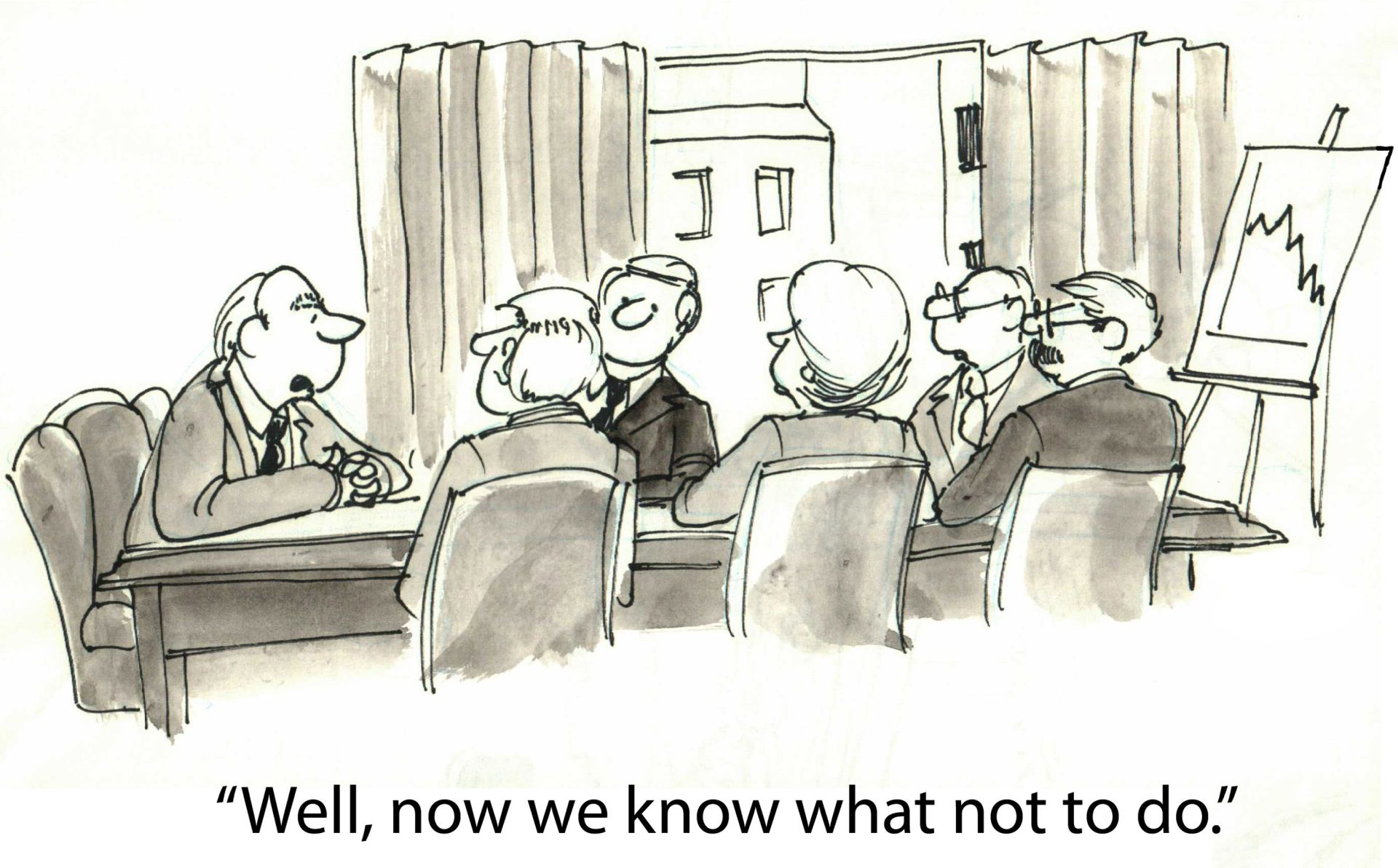
Skeptics Slow Down Projects
Every project needs critical minds during the planning stage who are able to bring their colleagues' exuberant enthusiasm back down to earth. What it doesn't need, however, are skeptics who immediately talk down every little idea and create insurmountable hurdles where there aren't any. Constructive criticism is helpful, but destructive criticism is not, because it slows down projects and stifles motivation. Such skeptics are often assigned by management to a young, dynamic group in order to let projects fizzle out without having to express their own rejection of the project idea.
Lack of Resources (Capital, Time, Materials)
Innovation projects in companies fail very quickly when the patience and understanding of decision-makers (often lawyers and ex-bankers) are relatively limited or non-existent. As time passes and results fail to materialize, decision-makers often turn off the money tap too early because they lack the courage to see the project through or because they do not share the vision of the innovation team and only look at the numbers. Instead of making innovation a key task in the company and providing continuous budgets for it, each individual project is viewed with suspicion and risky operations are terminated at an early stage. In their quest for innovation, large companies very often lose sight of “new markets” and “low-budget markets” because these are not the markets where their cash cows graze. Yet the attacks that develop from these markets over the years are the most dangerous, because this is the breeding ground on which disruptive innovations grow. If the innovation team lacks the necessary materials to try out their ideas, the time to develop and implement them, and the capital to test markets, success cannot be achieved.
Lack of Courage to Implement Consistently
As mentioned earlier, decision-makers often lack the courage to see an innovation project through to completion and implement it consistently. Decisions to abandon projects are often made under considerable time and financial pressure, and even small changes in the innovation process can have a major impact on subsequent marketing or customer benefits. In drug development, decisions about how the drug will be administered (e.g., orally, subcutaneously, intramuscularly, or intravenously) are made at an early stage. Impatient and money-hungry investors have already gambled away the future of many a blockbuster drug by pushing for rapid development instead of the right one.
Lack of Customer Perspective
In technology-driven developments, it is often the case that the technology itself takes center stage and the developers cannot imagine that the target audience, namely customers, might not share their enthusiasm for the end product, but would want something completely different from their perspective. This phenomenon is called “innovating past the market,” because instead of working toward a pull effect (customer demand), a push effect (developer vision) was created. And anyone who thinks of the automotive industry with all its superfluous sensors and electronic gadgets is not far off the mark.
Lack of Foresight on the Part of Management
The task of management is to keep costs low and revenues high in order to generate as much profit as possible. If you have a well-functioning business model with a decent cash cow, you want to milk the cow while it is still producing plenty of milk. That's why innovation is considered good form in most boardrooms, but woe betide any idea that dares to attack the cash cow – that's when the fun stops. Experience has shown that self-cannibalization can be the path to greatest success, because new innovation can replace old. And if you've only made stupid money so far, the way is now open to make stupid and silly money. Atari, Nokia, and Kodak lacked precisely this foresight. And where are they today?

According to a 2019 study by Gartner.com, it is the combination of soft factors (resistance to change, weak culture of innovation) and hard factors (compliance hurdles, misjudgment of risks) that leads to the frequent failure of innovations.
Resistance to Change
Resistance to change has already been discussed in relation to management's lack of foresight. Those who ridicule and ignore new trends have already steered their ship halfway toward the iceberg. Of course, it is acceptable to dismiss new trends and hyped market leaders, but under no circumstances should they be ignored or resisted when they slowly evolve into competition. As the Chinese fortune cookie so aptly states: “When the winds of change blow, some build walls, others build windmills!” And many who built walls for too long and then tried to ride the new wave with their windmills were already too late (e.g., Nokia, Kodak, Pan Am, Commodore, and others) and have been forgotten.
Weak Culture of Innovation
In innovation management, the culture of innovation is the fourth pillar, alongside skills, structure, and strategy. If the other three pillars are not integrated into everyday business life and innovation is only celebrated by employees once a year at Christmas but not lived out otherwise, a culture of innovation will never take hold. This is because a culture is determined by learned behaviors and manifests itself in the permanent creation and preservation of values (e.g., architecture, fashion, art, music, knowledge, food, etc.). The same applies to the culture of innovation. Here, too, mechanisms must be permanently created and values preserved so that an independent culture can develop.
Innovation cultures can develop more quickly in lean and small structures, such as start-ups and spin-offs, because innovation is practiced almost 100% of the time in these environments. However, this does not mean that medium-sized and large organizations cannot do the same. To do so, they must be prepared to assign small, independent innovation teams, give them a creative space, allow free communication, provide innovation processes with clear visions and strategies, allocate the necessary budget without constantly questioning it, and finally, not let marketable products disappear into the basement, but promote them in parallel with the existing market range.
Compliance Hurdles
Innovation thrives on creativity, freedom of thought, playing with unimagined possibilities, a willingness to take risks, and breaking new ground. This is completely at odds with compliance rules, which are often a nightmare for young entrepreneurs and innovators in large companies alike, because compliance is in direct contradiction to everything that innovation stands for. Compliance is the framework that guarantees stability and order, security, and fairness. The art for innovation managers now lies in using the remaining degrees of freedom within the rigid guidelines set by compliance rules to drive creative projects forward. For start-ups and spin-offs, speed and agility are often paramount. Too many regulations and rules can slow down the pace of innovation and inhibit growth. However, many rules exist for good reason, and it is important to regulatory authorities that market integrity, consumer protection, and data privacy are maintained. This is particularly essential in the healthcare and financial sectors.
Misjudgment of Risks
Innovation efforts always involve significant risks. It therefore makes sense to conduct a risk assessment in advance. This identifies, analyzes, and evaluates potential risks during the innovation process. External and internal factors play an important role in the assessment, including technological uncertainties (feasibility study), market dynamics (acceptance behavior), regulatory restrictions (IP issues), resource constraints (financial restrictions), and organizational culture (operational impact). If areas are overlooked during risk identification or misjudgments are made during the analysis, this can lead to the premature failure of innovation processes. Without risk, there is no opportunity. It is important to find the right balance. No industry knows this better than the pharmaceutical industry, which sometimes works for up to 20 years on the development of new active ingredients and their approval as drugs. Here, the potential benefits of each new project must be weighed against the manifold risks, such as failure in the various clinical trials (phases I-III), regulatory hurdles, or market competition.

Anyone who has made it this far without giving up knows that there are many factors that can influence and hinder the innovation process. And the larger a company is, the lower its transparency, flexibility for growth, tolerance for error, loyalty, and modesty to sometimes subordinate oneself to the team in order to achieve the greater good. However, these factors are essential for building a culture of innovation. In most cases, minor structural measures are sufficient to improve the work surrounding the innovation process. A place must be created within the organization where members can feel safe and where both trust and honesty are encouraged. Mistakes must be recognized as part of the creative process, and an implemented error analysis shows that mistakes do not have to be concealed or covered up, but can also be part of progress. This also creates a working environment in which the team feels comfortable and can therefore be more creative and productive. This also encourages members to take on responsibility and increase their commitment. It is fundamentally important to convey to employees that their work is important and meaningful. This also encourages members to take on responsibility and become more committed. It is fundamentally important to convey to employees that their work is important and meaningful. This is reinforced when management familiarizes all employees with the company's mission and promotes role models. It also helps not to start projects and then abandon them at the first hurdle. For innovation processes, it is important to provide a fixed budget that cannot be changed. Only then do creative projects have any chance of completing the difficult and challenging process chain to the end.

1) Warum versagen große Organisationen bei der Innovation? Atte Isomäki, Viima.com, 2022
2) 10 Gründe, warum Innovationsprojekte scheitern. Dr. Jens-Uwe Meyer, innolytics.de, 2020
3) Warum Innovationen scheitern – der Kontext zählt. Hans-W. Winterhoff, innotonic.de, 2021
4) Wenn Marktführer abstürzen: Diese bekannten Konzerne sind grandios gescheitert. Cornelia Meyer, Business Insider, 2021
5) A Disruptor’s Guide to Compliance and Innovation. Fastercapital.com, 2025
6) Innovationsrisikobewertung. Fastercapital.com, 2025